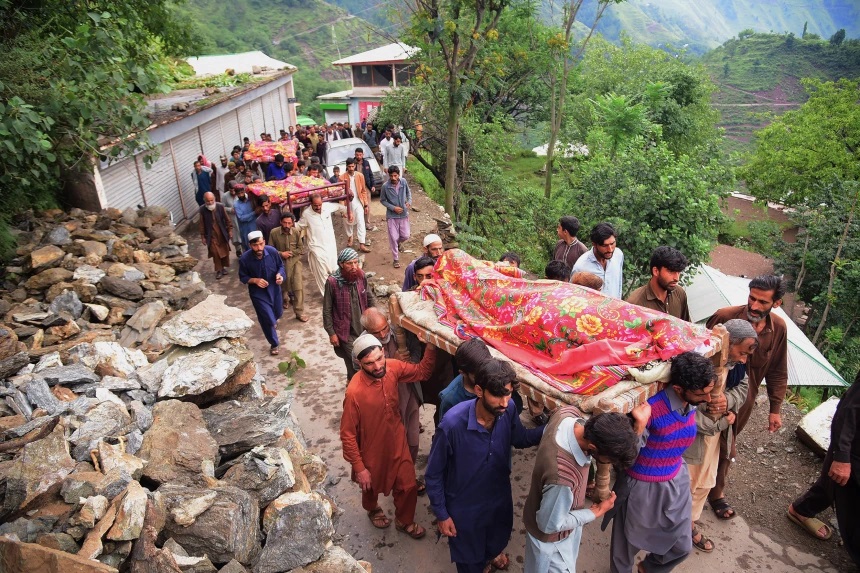
The phenomenon, which happens when intense rain falls on a very small region, particularly in hilly areas, is being made worse by climate change.
As climate change exacerbates what are known as “rain bombs,” or cloudbursts, severe deluges have engulfed entire villages in hilly India and Pakistan, killing over 430 people.
The majority of the victims were in Pakistan, where the provincial disaster management administration reported on Wednesday that over 370 people have died in the northwest region of Khyber Pakhtunkhwa since August 15. In one district, Buner, there were at least 228 fatalities and many more reported missing.
Cars and houses were washed away, and footage from the province showed entire streets transformed into muddy rivers.
According to Reuters, water flooded through the Kashmiri town of Chashoti last week, leaving at least 60 people dead and more than 200 missing in neighboring India.
A cloudburst is defined by the Indian Meteorology Department as four inches of intense concentrated rainfall in a single hour. Forecasters can accurately identify which states or provinces may experience heavy rainfall, but cloudbursts are hard to anticipate because of their localized nature, short duration, and suddenness, which makes them the source of significant damage and fatalities.
It seems as though the clouds are releasing all of their moisture simultaneously, akin to a rainstorm.
Khalid Khan, the chairman of the climate initiative PlanetPulse and a former special secretary for climate change in Pakistan, described the situation as “like an overhead tank has burst on top of a house.” “Instead of taking three days to fall, the rain falls in just one hour.”
The death toll has increased in some of the impacted areas due to a lack of early warning systems. Residents of Buner blamed Pakistani authorities for not issuing evacuation alerts, claiming that no broadcasts from mosque loudspeakers—a typical warning system in isolated locations—were heard.
Although the district has an early warning system in place, the authorities claimed that because of the suddenness of the downpour, the signals were sent out too late.
A Pakistani official from Khyber Pakhtunkhwa named Asfandyar Khan Khattak told The Associated Press that there is “no forecasting system anywhere in the world” that can pinpoint the precise position and timing of a cloudburst.
Although South Asia experiences heavy rains frequently during this time of year, experts generally concur that cloudbursts have become more frequent and intense in recent years, partly as a result of climate change.
Cloudbursts, according to scientists, are a sign of the catastrophic consequences that climate change may bring, as the planet is currently more than 1 degree Celsius (2 degrees Fahrenheit) warmer than it was prior to industrialization.
Air can store roughly 7% extra moisture for every degree Celsius that the temperature of the atmosphere rises. This makes rainfall conditions worse, especially in Pakistan, which is bordered to the south by the rising Arabian Sea and to the east by snow and melting glaciers.
According to Govindsamy Bala, a professor at the Indian Institute of Science in Bengaluru’s Center for Atmospheric and Oceanic Sciences, “seven percent is a very average number, and in some places for every degree of warming you can get up to twenty or twenty-five percent increase in rainfall intensity because the atmosphere can hold that much water vapor.”
The majority of cloudbursts also happen in mountainous areas, which are particularly prone to landslides and flash floods because the air is compelled to climb when it encounters high terrain, which causes it to quickly chill and condense into dense clouds.
Sudden downpours in Pakistan and India are caused by increasing moisture from the Indian Ocean and the Arabian Sea that enters the high regions of the Hindu Kush, Karakoram, and Himalaya mountain ranges.
Another cloudburst struck India earlier this month, this time in Uttarakhand, a state in the north, where floodwaters flooded into the Himalayan village of Dharali. Lt. Gen. Inam Haider, the chairman of the National Disaster Management Authority, told reporters in Islamabad last week that Pakistan had already received 50% more rain than it did at the same period last year.
The professor Bala stated, “We can tell whether it’s going to be heavy rain or light rain, but I don’t think anybody can forecast a cloudburst at that smallest scale.”
According to the Climate Risk Index created by the nonprofit organization Germanwatch, based in Bonn, Pakistan is the nation most impacted by extreme weather events, although contributing less than 1% of the world’s greenhouse gas emissions.
Pakistan proclaimed a state of emergency in 2022 after floods destroyed a tenth of the country, killing about 1,700 people. The World Bank estimated that $16 billion would be needed for rehabilitation.
However, there are steps that can be taken.
Khan added that a community-based strategy of drills, sirens, and messaging groups can aid in the early evacuation of inhabitants. “You can have localized warning groups, forecasts, instead of doing it from a faraway distance,” Khan said.
“We must be protecting ourselves,” he continued. “Just as Japan has constructed earthquake-resistant infrastructure, we also need flood-resistant infrastructure.”