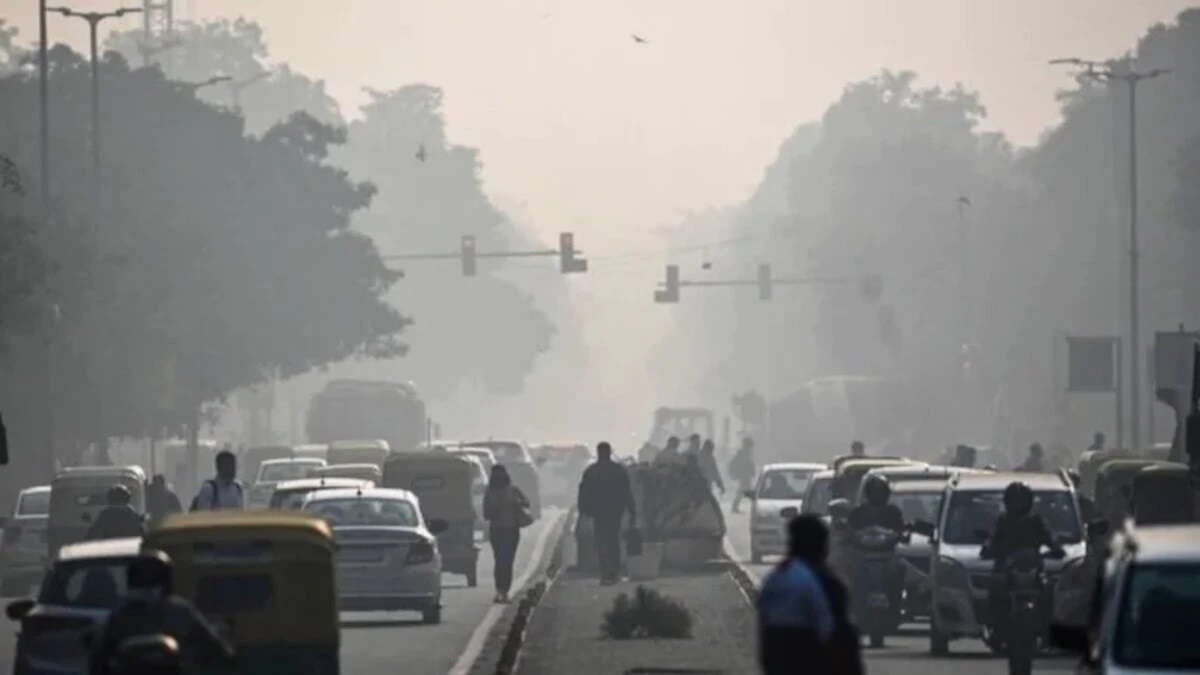
Hyderabad: Hyderabad has not struck the headlines as Delhi has in terms of air pollution, but hidden beneath layers of air quality index (AQI) statistics lurks a dusty and dangerous truth — that sections of the match Delhi’s poor air levels. The authorities’ lack of concern for warning citizens about potential threats and taking action to reduce pollution is the only difference. At least at two places where AQI is recorded in Hyderabad, the values hit and crossed 300 in Hyderabad, as late as the last week of November.
On November 27 and 28, TG Pollution Control Board (TGPCB) data showed that area around Nehru Zoological Park scored 300 and 305 AQI, putting that entire zone in the ‘very poor’ category, which according to the Central Pollution Control Board norms, might result in respiratory ailments. On the same dates, the air pollution at Icrisat in Patancheru was reported at 308 and 283 AQI, in the ‘very poor’ and ‘poor’ categories. Even the bad category is regarded as one that can produce in breathing irritation to persons on prolonged exposure. The Zoo Park and Icrisat locations routinely recorded ‘poor’ category of air quality on numerous days in November
Pashamylaram, Bolaram and Sanathnagar are the other places where the pollution was evaluated to be ‘poor’ last month. For similar AQI indices in Delhi, the government there enforces many steps under its Graded Response Action Plan (GRAP) with Stage-I measures for ‘poor’, and Stage-II actions for ‘very poor’ AQI categories. It’s interesting to note that the TGPCB, which is tasked with monitoring air pollution levels among other duties, operates under the “theory” that since there are 14 public display boards displaying air pollution levels, it is assumed that people are aware of what they are breathing in and will take the necessary precautions to avoid the negative effects of high pollution levels.
“According to the current ‘theory’ at the PCB, since the information is available, the board does not need to take any additional action,” a Pollution Control Board officer told Deccan Chronicle. “But the fact is there is certainly is a need for an alerting system but that can happen only if there is public pressure.” Interestingly, three of the 14 display boards that the PCB operates in the city, which covers an area of more than 650 square kilometers, are reportedly undergoing maintenance.
Officials also agree that even if all the boards are operating, the problem was that no one had bothered to find out if individuals saw the data, and if so, how much of it they understood, and what preventative measures they undertook.
Air Quality Index (AQI) and what it signifies
AQI category – Range – Impact Good – 0-50 – Minimal Satisfactory – 51-100 – Minor breathing discomfort for sensitive people Moderate – 101-200 – Breathing discomfort to the people with lungs, asthma and heart disease Poor – 201-300 – Breathing discomfort to most people on prolonged exposure Very poor – 301-400 – Respiratory illness to people on prolonged exposure Severe – 400 above – Affects healthy people and seriously impacts those with existing diseases What Delhi does under GRAP-I (poor AQI), and GRAP-II (very poor AQI)
GRAP Stage – I
A 31-point action plan including: Alerts by government via newspapers, TV and radio, social media, bulk SMS on pollution levels, dos and don’ts, inform on action being taken by government Vehicles that are obviously polluting should be impounded, and PUC regulations should be strictly enforced. Prohibit the use of wood and coal fires in tandoors in dining establishments. Periodic mechanical sweeping of roads, control dust pollution by sprinkling water, utilize anti-smog weapons to clear the air GRAP Phase II A 10-point action plan comprising numerous steps from Stage-I and Daily vacuum sweeping of selected roadways, water sprinkling on highways, proper disposal of accumulated dust Discourage private transport, enforce higher parking fees Stagger timings of public offices People to use public transit
PCB November 2025 data:
At Nehru Zoo Park Date – AQI – Category Nov. 1 –– 29 – Good Nov. 5 – 111 – Moderate Nov. 9 – 223 – Poor Nov. 10 – 227 – Poor Nov. 12 – 253 – Poor Nov. 14 – 243 – Poor Nov. 15 – 293 – Poor Nov. 16 – 260 – Poor Nov. 17 – 293 – Poor Nov. 18 – 287 – Poor Nov. 19 – 260 – Poor Nov. 20 – 200 – Poor Nov. 24 – 217 – Poor Nov. 25 – 260 – Poor Nov. 26 – 257 – Poor Nov. 27 – 300 – Very poor Nov. 28 – 305 – Very poor
@ Icrisat
Date, AQI, Category, Nov. 1–45; Good, Nov. 6–127; Moderate, Nov. 9–173; Moderate, Nov. 10–207; Poor, Nov. 11–230; Poor, Nov. 12–217; Poor, Nov. 15–217; Poor, Nov. 16–247; Poor, Nov. 18–223; Poor, Nov. 19–253; Poor, Nov. 25–153; Moderate, Nov. 26–240; Poor, Nov. 27–308; Very poor, Nov. 283; Poor
Other sites in city whose AQI hit the bad mark this November: Pashamylaram, Bolaram, Sanathnagar.