
New Delhi: China is taking calculated steps to position the Renminbi (RMB), its digital currency, as a potential substitute for the US dollar in international trade and finance. The initiative comes as several countries are searching for methods to lessen their reliance on the dollar as a result of the global impact of US tariffs. According to experts, China may have a significant advantage in international trade if it can create a digital currency system that enables direct trading between nations without converting local currencies into US dollars. The more significant question is still whether other countries will have enough faith in China to use its virtual money for cross-border transactions.
A few specialists clarified it. China’s new digital Yuan system could change international finance by establishing a different network for cross-border payments that is not under Western control, according to Dr. Narinder Kumar Bhasin, a retired vice president of Axis Bank, who spoke to ETV Bharat. Beijing’s new payment system processes transactions at speeds of less than ten seconds and functions outside of SWIFT standards. If it integrates well with ASEAN and Middle Eastern countries, it may facilitate local currency trading and lessen dependency on SWIFT and the US dollar.
Beijing directly confronts the three pillars of US dollar dominance—oil commerce, SWIFT (Society for Worldwide Interbank Financial Telecommunications) intermediates, and dollar-denominated reserves—by developing a substitute financial infrastructure that is quicker, less expensive, and impervious to sanctions. This is the emergence of a parallel financial world, not just economic competition,” he stated.
How it operates
He noted that China’s method quickly transfers real digital currency through its central bank network, in contrast to SWIFT, which simply transmits payment instructions between banks. It reduces transaction costs and settlement delays because it is quicker, less expensive, and independent of middleman institutions.
This extension circumvents the conventional SWIFT system, which has been the foundation of US dollar-denominated payments for decades, and links China’s blockchain-based financial infrastructure directly to approximately 38% of the world’s trade activity.
The central bank governor’s comments demonstrate China’s commitment to pursuing its digital currency program. In an effort to increase the Renminbi’s worldwide reach and influence, People’s Bank of China Governor Pan Gongsheng revealed plans to create an international operations centre for the digital Yuan earlier this year at the Lujiazui Forum in Shanghai.
The action was taken in the midst of growing trade and technological tensions with the United States, which have given Beijing’s attempts to advance the yuan’s worldwide use and establish Shanghai as a major financial hub a new feeling of urgency. The declaration also makes it apparent that China seeks to include other nations in its growing financial network in addition to securing its own use of the digital Yuan.
The answer to the question of whether the action will immediately lessen tariff pressures is yes. Indirect gains may result from any currency exchange or trade arrangement that allows nations to avoid using the US dollar. Since dealing in local or alternative currencies eliminates the additional expenses that typically accompany dollar-based transactions, it can make trading a little less expensive.
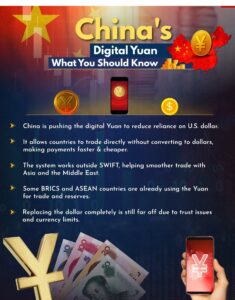
Will it result in cost savings?
“Assume you are a Japanese buyer and I am an Indian seller,” said the creator of the Global Trade Research Initiative (GTRI), a former Indian Trade Service official. When the items are delivered to Japan, the payment procedure starts. When I get paid in dollars, I have to exchange it back into Indian rupees because Japan first transforms its currency into US dollars. The fee for each of these conversions is approximately 3–4%. Therefore, it would avoid those additional expenses and directly boost earnings if we created a system that permits commerce without currency translation.
Additionally, he said that almost 70% of international trade entails conversion into US dollars before being converted into local currencies. He claims that although India and a number of other nations have attempted to develop their own systems to lessen reliance on the US currency, these initiatives have not made much headway. On the other hand, China has made great strides in this direction, which he views favourably.
Regarding domestic imports, he continued by saying that China has begun purchasing oil in its own currency and that India is also buying oil from Russia using a non-dollar payment method, albeit a different one. Finally, he stated that if more nations followed suit, it would not only speed up international payments but also result in significant cost savings.
China is promoting the program for geopolitical and technological reasons, according to Dr. Bhasin. By providing partners with a system that is not dominated by the US or Europe, it hopes to modernise payments, increase efficiency, and simultaneously increase its financial clout. The digital yuan in China has demonstrated that state-backed, safe, quick, and large-scale CBDC rails are possible.
He claimed that this has subtly aroused interest from countries in Africa, Latin America, and some parts of Asia, where they see CBDCs as low-risk, high-efficiency substitutes for the dollar system.
Will the dollar be replaced by this?
This might gradually erode the dollar’s hegemony in trade agreements, particularly in the energy and local business sectors. But it’s unlikely that the dollar will be fully replaced very soon. The majority of nations continue to have faith in the dollar’s liquidity and stability. The Digital RMB combines statecraft, technical innovation, and economic sovereignty.
About 90% of the BRICS countries’ total commerce is now handled in local currencies, with the Yuan accounting for only 24% of intra-block trade as of early 2025. Dr. Bhasin stated that a number of ASEAN economies, such as Malaysia, Singapore, and Thailand, have started to keep RMB in reserve and use the digital yuan for transactions involving commodities or energy.
Sarbartho Mukherjee, a senior economist at CareEdge and trust defecit, told ETV Bharat that China has been working to challenge the US dollar’s hegemony for a long time by internationalising the Yuan and trading currencies bilaterally.
With the advent of the digital Yuan, China and its trading partners may now exchange currencies directly, facilitating instantaneous transactions without the need for the dollar. Although trade between and within Asia may profit from these developments, the global financial system is not likely to be significantly impacted in the near future.
It is unrealistic to expect the digital Yuan to completely replace the dollar; if it does, it will probably take decades. For the time being, the dollar still rules global finance and trade. In the meantime, India is also gradually internationalising the rupee, which is in line with a larger global trend in which nations look for methods to increase the significance of their own currencies on a worldwide scale.
Because China lacks full capital account convertibility, you will receive Chinese currency if you buy an asset there rather than being able to easily exit and convert it back into dollars. Furthermore, even though China is becoming a major economic force, a barrier still exists because of the lack of international confidence in its currency. For the yuan to have enough credibility to rival the dollar, the world community must have faith in it. He went on to say that these two problems will continue to severely restrict the Chinese currency’s widespread worldwide appeal.
The dangers of using China’s payment system
Using China’s payment network, Dr. Bhasin warned, may make nations dependent on Chinese digital infrastructure and expose their transaction data to Chinese officials, thereby reducing their financial independence. Furthermore, Indian exporters may suffer if China’s digital currency or settlement system lowers the cost of Chinese goods or facilitates settlement.
India may become more dependent on Chinese financial infrastructure or more exposed to RMB exchange rate risk if more trade settles in RMB. Globally, the emergence of digital currencies is altering banking and payment processes. Therefore, he argued, India needs to protect itself against threats to its financial system, deposit migration, etc.
In order to prevent becoming overly dependent on any one power, other nations should continue to be aggressive but careful, building their own safe digital payment systems or regional substitutes while also cooperating where it facilitates commerce. The digital rupee in India is still in its infancy, and many CBDCs are not widely used worldwide. Dr. Bhasin suggested that India should make sure that there are real use cases, user uptake, or risk investments that are not being fully utilised.