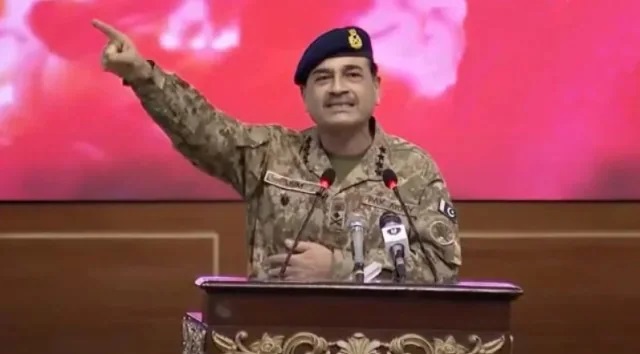
New Delhi: New Delhi said Monday that it has already made it plain that it will not accept nuclear blackmail in response to Pakistan Army Chief Field Marshal Asim Munir’s most recent tirade against India. While on a visit to the United States, Munir stated that if India moves on with building a dam on the Indus River, Islamabad will protect its water rights “at all costs.” According to Pakistan-based media outlet ARY News, he once again referred to Kashmir as Pakistan’s “jugular vein” and stated that it is an unresolved international issue rather than an internal issue of India.
According to a report published Monday in The Dawn, Munir informed members of the Pakistani-American community in Tampa, Florida, “We will wait for India to build a dam, and when they do, we will destroy it.”
India will “continue to take all steps necessary to safeguard our national security,” according to Ministry of External Affairs spokesperson Randhir Jaiswal.
“Remarks purportedly made by the Pakistani Chief of Army Staff on a visit to the United States have caught our attention. Pakistan’s specialty is nuclear sabre-rattling. “The irresponsibility inherent in such remarks, which also reinforce the well-held doubts about the integrity of nuclear command and control in a state where the military is hand in glove with terrorist groups, can be left up to the international community to decide for itself,” Jaiswal said.
The fact that these comments ought to have been made from the territory of a friendly third nation is equally regrettable. India has previously stated unequivocally that nuclear blackmail will not be tolerated. We will keep doing everything we can to protect our national security,” he continued.
“Such statements indicate the possibility of further terrorist attacks, with Pakistan’s missile and nuclear capabilities used as political cover,” according to earlier reports from sources in Delhi.
Sources in Delhi responded to these remarks by claiming that Pakistan has been using the nuclear bogey for decades and that this is its nuclear blackmail. Due to the non-trivial possibility of nuclear materials or expertise reaching non-state actors, it is generally seen as an irresponsible nuclear-armed state. An organization like the Pakistani military, which has no accountability to anyone, is not trusted by the world community to handle nuclear weapons, the insider stated.
The sources referred to it as “nuclear sabre-rattling” and stated that Islamabad has a history of assuming the mantle of a “responsible” nuclear actor while engaging in rhetorical nuclear brinkmanship. According to the sources, a military apparatus that essentially “holds the nuclear button” is the main cause of nuclear instability in South Asia. They also described it as a source of regional instability.
A few weeks prior to the Pahalgam incident, Munir declared that “it was our jugular vein” and that Pakistan will never forget the Kashmir dispute. India denounced his remarks.
The Pakistani army said in a statement that Munir, who is in the United States on an official visit, has met with high-level members of the Pakistani diaspora and top military and political figures.
Highlights of Munir’s address to the Pakistani community indicate that he claimed that Kashmir is “an incomplete international agenda rather than an internal matter of India.” Kashmir is Pakistan’s “jugular vein,” as the Quaid-e-Azam once stated.
Munir claimed that the US-Pakistan relationship has taken on a new dimension with his second trip to the US after a one-and-a-half-month hiatus. He went on to say that the goal of these visits is to steer the relationships in a constructive, long-lasting, and good direction. Munir said that Pakistan is incredibly appreciative to US President Donald Trump, whose strategic leadership has saved numerous wars worldwide, including the conflict between India and Pakistan.
During his unusual five-day journey to the US in June, Munir joined Trump for a private luncheon—a rare event usually reserved for visiting leaders of state or government. Trump announced increased US-Pakistan cooperation in a number of areas, including an energy contract, at the end of that meeting.
Munir attended the retirement ceremony of General Michael E. Kurilla, the departing Commander of the United States Central Command (CENTCOM), and the Change of Command Ceremony in Tampa, where Admiral Brad Cooper took over as commander, according to a release from the Pakistani army.
Additionally, Munir met with General Dan Caine, Chairman of the Joint Chiefs of Staff, “where matters of mutual professional interest were discussed.” “General Caine was invited to come to Pakistan by him.
COAS engaged with friendly country chiefs of defense on the sidelines.
“COAS encouraged the Pakistani diaspora to actively participate in luring investments and to maintain faith in Pakistan’s promising future during an engaging session with them. The statement claimed, “The diaspora reaffirmed their commitment to supporting Pakistan’s progress and development.”