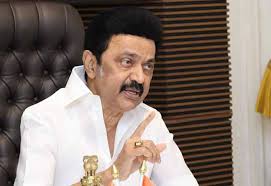
Chennai: M K Stalin, the chief minister of Tamil Nadu, criticized the central government on Wednesday for rejecting Metro Rail projects for Madurai and Coimbatore, calling the action “revenge” on the state’s citizens. Despite comparable projects being approved in other smaller towns in BJP-ruled states, Stalin claimed in a post on ‘X’ that the Center had warned the state “No metro” for the “Temple City” of Madurai and “South India’s Manchester” Coimbatore.
“On tenuous grounds, the Union BJP administration has rejected Metro Rail for Temple City Madurai and Manchester, Coimbatore, South India. The purpose of a government is to serve the people impartially. CM Stalin stated in his post, “Yet the Union #BJP treats #Tamil Nadu’s democratic choice as a reason to take revenge.” According to reports, Tamil Nadu’s Detailed Project Reports for the two Tier-II cities were recently returned by the Union Housing and Urban Affairs Ministry, citing the Metro Rail Policy, 2017, which limits central support to urban agglomerations with a population of at least 20 lakh according to the 2011 Census.
The Center has noted in its response rejecting the state’s recommendations that Coimbatore and Madurai, with populations of roughly 15.84 lakh and 15 lakh, respectively, in 2011, fell short of that criteria. The chief minister questioned what he called a “uneven application” of the policy, pointing out that Metro projects have been allowed in towns like Patna, Bhopal, and Agra, which are in BJP-ruled states but also fall below the 20 lakh threshold.
He argued that the union government was using Tamil Nadu’s democratic decision against the BJP as justification to “take revenge” by depriving its citizens of essential infrastructure. Stalin called the rejection of the projects “disgraceful” and stated that a government must operate in a way that is equitable to all and not exhibit such a “mean approach” of punishing opposition-ruled states. He referred to Coimbatore as the “Manchester of South India” and Madurai as “Kovil Nagar” (Temple City), saying that both cities should have access to contemporary mass transit systems. He also charged that the Center’s “No Metro” attitude diminished their ambitions.
The chief minister declared that his government and the residents of Madurai and Coimbatore will “defeat” what he claimed was the BJP’s spiteful plan and guarantee that Metro Rail is implemented in both cities. Before the most recent rejection, Tamil Nadu submitted DPRs, a Comprehensive Mobility Plan, and an Alternative Analysis Report for the two projects between February and December 2024. The Center notified Parliament in March of this year that they were being reviewed. Tamil Nadu can resubmit using urban agglomeration (UA) data (Coimbatore UA is 21+ lakh) or provide specific justification, according to Vanathi Srinivasan, National President of the BJP Mahila Morcha. This is similar to how Agra Metro was allowed for tourism. Patna and Bhopal have comparable precedents.
“TN has received Rs 1.5 lakh crore in rail funds under NDA –hardly the sign of any anti-Tamil Nadu agenda,” stated Srinivasan. The union government has not approved metro in cities with fewer than 20 lakh residents, according to BJP State Media Spokesperson Narayanan Thirupathy. “Cities such as Bhopal (23 lakh), Kanpur (29.3 lakh), Nagpur (25.5 lakh) Indore (22 lakh) and Surat (73.3 lakh), and the population figures of those cities together with their adjoining suburban areas (UA, are all above 20 lakh, and the respective states have clearly mentioned those statistics in detail in their DPR,” stated Thirupathy.
The Metro proposals are a part of the DMK government’s larger initiative to improve connectivity in the state’s rapidly expanding industrial centers and extend mass transit beyond Chennai. Stalin has repeatedly brought up this demand with the Union government, including in previous representations requesting approval for the Coimbatore and Madurai Metro Rail.