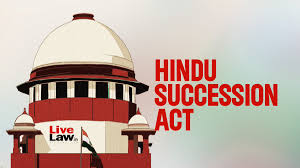
New Delhi: In order to prevent future legal issues between their parents and in-laws, the Supreme Court on Wednesday urged all women without kids, daughters, or husbands to draft a will. The top court cited the Hindu Succession Act of 1956 and stated that although Parliament at the time may have believed that women would not own property of their own, the advancement of women in these decades cannot be understated.
“Women in our nation, including Hindu women, have acquired self-acquired property as a result of their education, job, and entrepreneurship. If a Hindu woman passes away intestate without having kids, daughters, or a husband, and such self-acquired properties are solely to be inherited by the husband’s heirs, this could potentially generate heartburn for the mother’s family. The Supreme Court declared, “We do not make any observations in this regard either.
A panel of Justices B V Nagarathna and R Mahadevan suggested while disposing of a PIL filed by a woman counsel contesting Section 15(1)(b) of the Hindu Succession Act, 1956. According to Section 15(1)(b) of the Act, when a Hindu woman dies intestate, her property devolves to her husband’s heirs first before her own parents. Advocate Snidha Mehra’s plea claimed that the clause should be overturned because it was arbitrary and violated Articles 14, 15, and 21 of the Constitution.
She maintained that if a Hindu woman passes away intestate and has no kids, daughters, or husband, her assets will only pass to the husband’s heirs. “In accordance with section 30 of the Hindu Succession Act read with the provisions of the Indian Succession Act, we urge all women, especially Hindu women, regardless of age, who are likely to be in position under Section 15(1) of the Hindu Succession Act, 1956, to take immediate action to make a testament or will bequeathing their properties, including their self-acquired properties.
“We say so in order to safeguard the interest of not only women in this country in general but female Hindus in particular so as to avoid any further litigation in this regard,” said the court. In his appearance on behalf of the Center, Additional Solicitor General K M Nataraj opposed the PIL, arguing that the petitioner cannot challenge these issues because they must be brought up by the impacted parties. According to Nataraj, the clause was created in 1956, and Parliament would not have taken into account the possibility that a Hindu woman may obtain property on her own.
Additionally, the top court mandated that before initiating a lawsuit in court, the parties must undergo pre-litigation mediation if a Hindu woman passes away without a will and her parents or their heirs claim her property. The bench stated that any settlement achieved through mediation must be regarded as a court decree. “In the event that section 15(2) does not apply and the parents or heirs of the parents of a female Hindu dying intestate, as specified in section 15(1)(c), (d), and (e), make a claim to the estate of a Hindu female dying intestate, we instruct the parties to proceed with mediation in the first instance.
The bench declared, “We mandate that a pre-litigation mediation be held before any lawsuit or legal proceeding is filed. The highest court had previously stated that it would proceed slowly when reviewing challenges to the Hindu Succession Act, 1956, and that it would be cautious about upending the Hindu social structure and its fundamental principles, which have been in place for thousands of years. It had stated that “a balance between social structure and giving rights to women” was necessary, notwithstanding the importance of women’s rights.