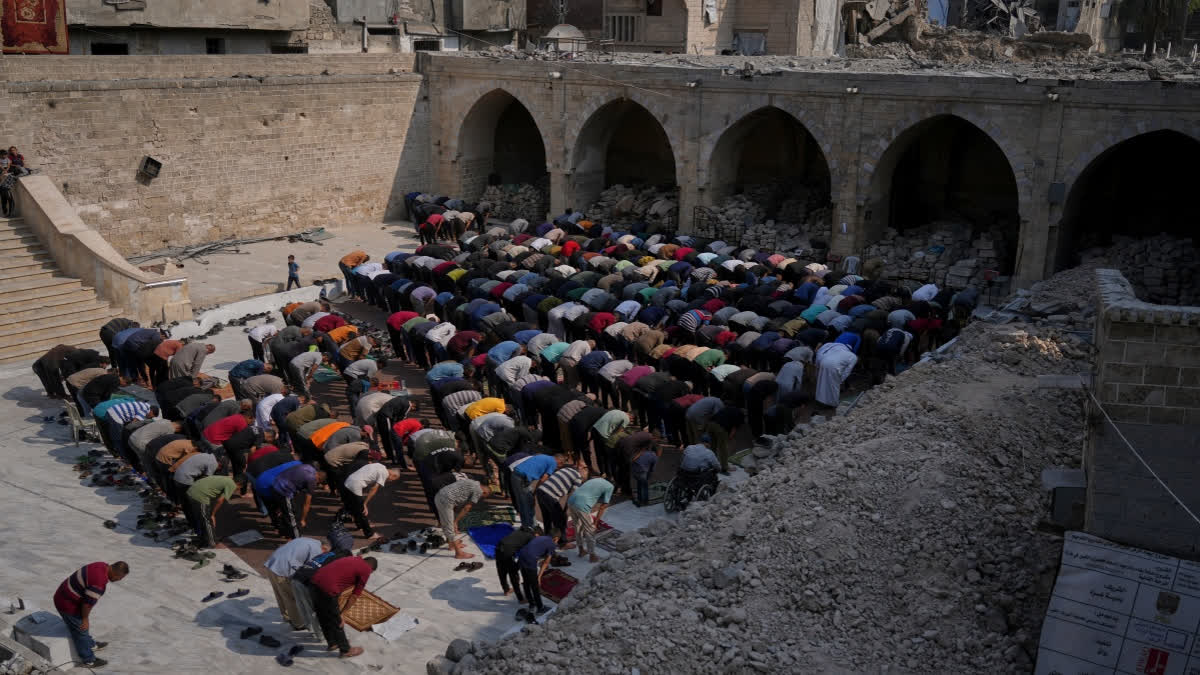
Khan Younis: As Israel and Hamas concluded the most recent body exchange under the terms of the precarious ceasefire agreement, Gaza health officials reported on Saturday that over 69,000 Palestinians have died in the Israel-Hamas conflict thus far.
Since the truce started on October 10, more dead have been found beneath the debris in the devastated strip, and previously unidentified bodies have also been recognized, which is responsible for the most recent increase in fatalities. It also includes Palestinians who have died as a result of attacks on the area since the truce began, which Israel claims are intended to eliminate any remaining militants.
According to hospital officials in the Gaza Strip, Israel earlier on Saturday returned the bodies of fifteen Palestinians to Gaza, suggesting that the deal, despite its fragility, is holding. The transfer took place one day after extremists gave Israel back a hostage’s remains.
The first part of the ceasefire agreement, which calls for Hamas to return all hostage remains as soon as feasible, is around the exchanges of the deceased. The goal of the ceasefire is to end the bloodiest and most damaging conflict between Israel and the terrorist Palestinian organization.
About 1,200 people were killed and 251 were held hostage in the Hamas-led invasion on southern Israel on October 7, 2023. As settler violence in the occupied West Bank reaches new heights, Israeli settlers also launched two attacks on Palestinian farmers, paramedics, activists, and journalists on Saturday.
Gaza’s death toll rises
Authorities in Gaza are still recovering bodies amid extensive wreckage with little equipment and resources, over a month after the ceasefire between Israel and Hamas.
Following the identification of more victims and the recovery of more bodies, the Gaza Health Ministry reported that the overall number of deaths in the Gaza Strip since the Hamas-led offensive on Israel on October 7, 2023, had increased to 69,169.
The ministry, which is part of the government governed by Hamas and employs medical professionals, keeps thorough records that independent experts consider to be generally trustworthy. According to the government, 284 more individuals were added to the number after their identities were confirmed between October 31 and November 7.
Additionally, the ministry reported that over the last three days, ten bodies—nine recovered from beneath the debris and one newly killed—as well as six injured had been sent to Gaza hospitals. It further stated that many Palestinians are still unaccounted for. The Health Ministry reports that 241 people have died in Gaza since the ceasefire started on October 10.
For each Israeli hostage returned, Israel has been releasing the remains of 15 Palestinians. Following the return of Rudaeff, Israel on Saturday handed over the 15 Palestinian bodies and Nasser Hospital in the central Gaza city of Khan Younis confirmed receiving them.
Hostage bodies still in Gaza
Israel affirmed on Saturday that the remains returned the night before belonged to an Israeli hostage who perished while battling Hamas during the militants’ initial assault. The office of Prime Minister Benjamin Netanyahu released a statement identifying him as Lior Rudaeff.
Rudaeff was born in Argentina and relocated as a child to Kibbutz Nir Yitzhak, an agricultural community in southern Israel, according to the Hostages and Missing Families Forum. He served on the community’s emergency response team and drove ambulances as a volunteer for almost 40 years.
Five hostages remain in Gaza after 23 hostages, including Rudaeff, were freed by Palestinian terrorists since the ceasefire began. 300 Palestinian dead have been turned over by Israel thus far. Without access to DNA testing, Gaza’s medical authorities have had difficulty identifying the remains; thus far, they have identified 89 of them, according to Gaza’s Health Ministry.
Once more, settlers attack the Palestinian olive crop.
As settler violence hits new heights during this year’s olive harvest, Palestinian health officials reported that 11 persons, including journalists, medical professionals, foreign activists, and farmers, were hurt in an attack by Israeli settlers in the West Bank.
The attack occurs just days after the U.N. humanitarian office reported that October saw more attacks by Israeli settlers against Palestinians and their property in the West Bank than any other month since the agency started monitoring the situation in 2006. According to the office, there were more than 260 attacks, or eight incidents every day on average.
To assist Palestinian farmers in securely traveling to and from their fields, activists and medical professionals have gathered to this year’s olive harvest. Over the past few weeks, the groups have been attacked several times.
Speaking shortly after his release from the hospital, Pollak said it would be wrong to think of the attack as an isolated action taken by extremist settlers. To him, it was just the latest episode in a string of similar onslaughts.
A video that was making the rounds in Palestinian media depicted the inside of a hospital in the West Bank where the injured from Saturday’s attack on the village of Beita were taken, bandaged and covered in blood. The group that was targeted included longtime solidarity activist Jonathan Pollak. In an interview, he told the AP that as he was gathering olives, dozens of masked Israeli settlers with clubs suddenly appeared, chasing them and throwing rocks.
To escape the assault, he dashed down a steep slope. According to Pollak, he witnessed a journalist and her security guard being surrounded by five settlers. He saw her helmet dented by the settlers’ beatings and bludgeoning. After being struck in the back of the head by a rock, Pollak was admitted to the hospital.
“We see this pattern every day,” Pollak remarked. “Israeli policy aims to ethnically purge Palestinians from their land, and this is just one finger in the iron fist.”
Rights organizations claim that indictments and imprisonment for settler violence are extremely uncommon. In 2022, the left-leaning Israeli newspaper Haaretz revealed that, according to Israeli police records, just 3.8% of settler violence instances resulted in charges, with the majority being opened and closed with no action done.
Another settler attack in the neighboring town of Burin was reported by Palestinian paramedics on Saturday. Four foreign activists and a 57-year-old male were hurt by settlers, according to the Palestinian Red Crescent. Regarding both incidents, the military refrained from commenting right away.