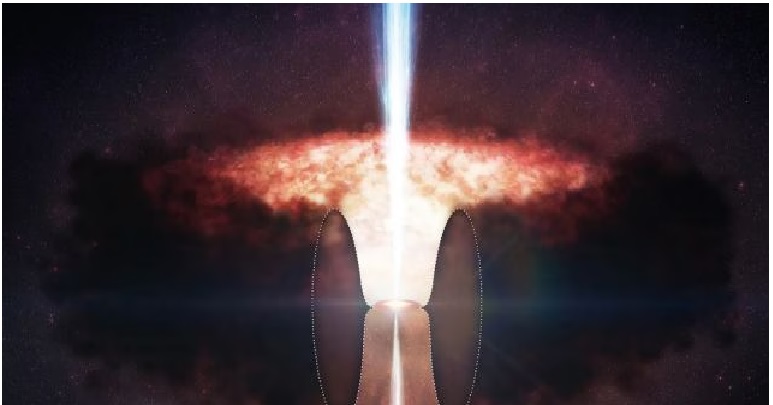
Scientists may have discovered a whole new class of stellar explosions after recording what may be the first known instance of a big star exploding while interacting with a black hole.
The Zwicky Transient Facility made the initial observation of the star, known as SN 2023zkd, in July 2023 in California. Artificial intelligence (AI) that can quickly detect anomalous cosmic phenomena was used to detect the star, which is located in a galaxy with little star formation activity some 730 million light-years away. The early warning, according to a statement, enabled telescopes in orbit and throughout the globe to start observations right once, catching the event in its early phases.
“2023zkd shows some of the clearest signs we’ve seen of a massive star interacting with a companion before explosion,” said Ashley Villar, a co-author of the paper and an associate professor of astronomy at Harvard University. We believe AI will help us find an entire class of hidden explosions, of which this may be a part.
At first glance, the star seemed to be a normal supernova, a bright flash that progressively faded over time to indicate the demise of a massive star. But months later, astronomers noticed that it brightened once more. Prior to the explosion, the system’s brightness had been gradually rising for almost four years, or 1,500 days, according to historical data. The star was under a lot of gravitational stress, as evidenced by the unusually long pre-explosion phase.
The most likely explanation, according to experts, is that the star was trapped in a black hole’s orbit. The star had two major eruptions in the years prior to its demise, expelling copious amounts of gas, according to evidence from light curves and spectra. The blast wave created the first light peak of the explosion, and months later, a second peak was created by a slower, longer impact with a dense, disc-shaped cloud.
The star might have collapsed as a result of the black hole’s gravitational attraction over time. The group also speculates that the black hole may have eaten the star before it could have exploded on its own. In that scenario, debris striking the surrounding gas would have produced the supernova’s luminosity. In any case, the effect would be a larger black hole.
According to Alexander Gagliano, the study’s principal author and a researcher at the Institute for Artificial Intelligence and Fundamental encounters, SN 2023zkd “is the strongest evidence to date that such close interactions can detonate a star.” “The majority of massive stars are in binaries, as we’ve known for a while, but it’s extremely rare to catch one exchanging mass just before it explodes,” he said.
These findings, according to the experts, show how AI can spot uncommon cosmic occurrences in time for in-depth analysis. Over the next ten years, they also highlight the significance of future infrastructure such as the Vera C. Rubin Observatory, which can survey the entire southern sky every few nights from its location in the Chilean Andes.
By finding and analyzing more of these rare and intricate events, Rubin Observatory’s observations, when combined with real-time AI detection, may help astronomers gain a better understanding of the lifespan of big stars in binary systems.
“We’re about to enter a time when we can automatically identify these uncommon occurrences as they happen, rather than just after they happen,” Gagliano said. “That’s really exciting because it means we can finally start connecting how stars live with how they die,” he continued.
On Wednesday, August 13, the Astrophysical Journal issued a study outlining these observations.